

Flipping the Flip: How to Buy, Improve, and Re-Sell Websites for 30% Profit
The digital asset ecosystem has completed its transition from a speculative, hobbyist sandbox into a highly sophisticated, institutional-grade branch of alternative asset management. In the current 2026 economic landscape, the historical strategy of buying a thin content site, mass-producing low-tier programmatic articles, and hoping for an exit has been completely eradicated.
Following successive core algorithmic overhauls and the global deployment of AI Search Overviews across the major search engines, organic click ecosystems have fundamentally restructured. Today, genuine value is anchored entirely in Operational Efficiency and Structural Defensibility.
For quantitative capital allocators, content creators, and portfolio managers looking to hit predictable alpha, the modern “Website Flip” is treated with the same analytical rigor as traditional mid-market corporate private equity. Taking a structurally sound but operationally neglected digital property, clearing its technical debt, optimizing its monetization stack, and exiting to institutional buyers who prize cash-flow stability over volatile “growth hacks” is the definitive playbook.
Within this modernized framework, targeting a 30% net profit within a compressed 180-day operational cycle has become the baseline benchmark for professional operators.
1. The 2026 Buy-Improve-Sell Lifecycle
Achieving a net 30% return on invested capital (ROIC) within a six-month window is not a product of luck; it is a rigid mathematical formula executed across three distinct operational phases. The contemporary macro strategy hinges on an arbitrage of entry and exit multiples, paired with immediate, high-impact conversion optimization.
By purchasing an undervalued asset at a conservative baseline multiple, executing precise tactical upgrades to lift top-line revenue, and staging the business to exit at an institutional premium, the 30% margin is mathematically locked.
Phase 1: Strategic Sourcing (The “Buy”)
The objective of the buy side is to isolate “Diamonds in the Rough”—digital real estate displaying highly stable audience retention and structural authority, but choked by sub-optimal monetization setups, decaying user interfaces, or legacy technical debt.
- Flippa: For active value investors, Flippa represents the premier sourcing engine for finding mispriced digital properties. By utilizing advanced portal logic—specifically filtering for “First-Time Sellers” or legacy corporate spinoffs—buyers can locate listings that lack professional data rooms or optimized presentation. This informational asymmetry is precisely where buy-side alpha is generated. Sourcing an asset on Flippa directly from an unpolished founder allows professional operators to negotiate clean entry multiples well below broader market averages.
- Acquire.com: This platform serves as a primary destination for micro-SaaS and software utility flips. The focus here should be on founder-led web applications where active outbound marketing has ceased, but baseline product utility keeps user churn exceptionally low.
- Empire Flippers: Positioned as a fully curated, managed marketplace, it commands higher baseline entry multiples. However, it provides pre-vetted financial tracking, making it a viable sourcing channel for investors looking to acquire larger content-to-commerce hybrids in the $50,000 to $150,000 range, where rapid revenue diversification can be implemented immediately.
Phase 2: The “30% Optimization” (The “Improve”)
Once the asset is onboarded, the optimization clock begins. In 2026, value creation is centered on User Experience (UX) engineering, technical consolidation, and yield optimization.
- The Technical Speed Flip: Legacy sites frequently suffer from heavy, unoptimized codebases and poor server infrastructure. Migrating the acquired asset to enterprise-grade edge hosting networks (such as Cloudflare Enterprise or specialized high-performance stacks) immediately resolves Core Web Vitals liabilities. Improving the Largest Contentful Paint (LCP) and Interaction to Next Paint (INP) metrics by just one second routinely triggers an immediate 7% to 10% lift in programmatic e-commerce conversion rates without acquiring a single new visitor.
- The Algorithmic Content Cleanup: Search algorithms now rigorously penalize shallow informational architecture. Operators must deploy optimization engines like SurferSEO or MarketMuse to execute a sweeping content audit. Legacy, underperforming pages should be pruned, consolidated, or upgraded to “Human-Plus” status—retaining AI efficiencies for structural data framing but using verified subject matter experts to inject real-world authority and proprietary data insights.
- Monetization Stacking: A staggering number of independently owned web properties still run legacy ad networks with basic code implementations. Transitioning an asset from standard Google AdSense to premium, AI-driven programmatic ad management platforms like Mediavine or Ezoic can increase Revenue Per Mille (RPM) by 20% to 40% overnight through automated layout testing and access to premium direct-sales inventory.
2. Platform Feature Comparison for Modern Flipping
The infrastructure supporting digital M&A has matured, with different marketplaces serving distinct phases of an asset’s capital cycle.
| Platform | Core Target Asset | Core Operational Advantage | Best Strategic Role in Flip |
| Flippa | Cross-Category (SaaS, E-comm, Content) | High-volume global inventory, instant platform verification APIs | Primary Sourcing Engine for capturing underpriced listings |
| Investors Club | Established Content & Media Assets | Deep, pre-packaged SEO auditing and automated backlink profiling | Sourcing stable, premium content plays |
| Motion Invest | Micro-to-Mid Content Portfolios | Dutch auction pricing mechanics (valuations drop dynamically daily) | Locating low-cap, rapid-turnaround assets |
| Quiet Light | High-Value Premium Brands ($500k+) | High-touch brokerage that frames operational systems for institutional exits | Premium Exit Channel for high-tier portfolio sales |
3. The 2026 “Exit” Strategy: Selling for the Premium
To successfully secure your 30% profit target upon exit, you must realize a fundamental truth of the modern market: Institutional buyers do not buy websites; they buy automated cash-flow systems. To command a top-tier valuation multiple on the sell side, you must strip away all founder-dependency from the asset.
Standard Operating Procedure (SOP) Documentation
Every operational layer required to run, maintain, and update the website must be fully productized. Utilizing step-by-step video capture tools like Loom or automated documentation platforms like Scribe, create a turnkey operational handbook for the incoming buyer. Documenting content publishing loops, technical maintenance schedules, and customer support flows transforms a volatile web property into an institutional-grade passive asset, justifying a premium multiple expansion upon resale.
Verification of Financial Ledger Integrity
Modern buyers will not accept self-reported spreadsheets or manually altered financial statements. Ninety days before listing the asset for exit, establish direct, read-only API links between your core payment processors (such as Stripe or PayPal) and automated analytics engines like ProfitWell, Baremetrics, or Flippa’s integrated verification ledger. Providing clean, tamper-proof, real-time data visualizers eliminates frictional due diligence delays and builds immediate buyer confidence.
The “Add-Back” Optimization Strategy
During the staging phase, meticulously audit your operational ledger to extract “One-Time Expenses” that do not reflect the ongoing operational costs of the business. Initial software development sprints, premium theme purchases, legal setup fees, and corporate migration costs should be legally categorized as add-backs to your Earnings Before Interest, Taxes, Depreciation, and Amortization (EBITDA).
The Leverage of Add-Backs: Every dollar successfully identified and justified as a one-time operational add-back increases your annual EBITDA. At a standard 3x market exit multiple, finding just $500 of non-recurring monthly expenses adds an instant $18,000 to your final cash exit price.
FAQ: Critical Insights for Portfolio Operators
Is traditional “Domain Flipping” still viable?
The legacy practice of purchasing raw domain names and holding them for passive appreciation has become highly illiquid and capital-inefficient. The contemporary premium play is “Development Flipping”—acquiring a high-authority expired domain with clean historical backlink equity and instantly deploying a Minimum Viable Product (MVP), a modular SaaS utility, or a programmatic content hub onto it to establish immediate operational cash flow.
How does the “Silver Tsunami” impact the digital asset market?
A massive percentage of foundational content hubs, niche media platforms, and early e-commerce setups are owned by individuals looking to retire. These properties frequently possess immense, irreplaceable domain authority built over 10 to 15 years, yet outdated layouts and non-optimized monetization structurally bottleneck them. This demographic shift provides modern acquisition entrepreneurs with an unprecedented pipeline of high-ROI target assets.
What is the single largest Due Diligence red flag?
An anomalous, unexplained spike in traffic volume or ranking keywords in the 60 days immediately preceding a sale listing. Rogue sellers routinely run short-term, low-quality pay-per-click (PPC) ad campaigns or temporary private blog network (PBN) link injections to artificially manipulate their trailing metrics. Always audit the historical traffic profile across a minimum 24-month horizon using Ahrefs or Semrush to verify long-term stability.
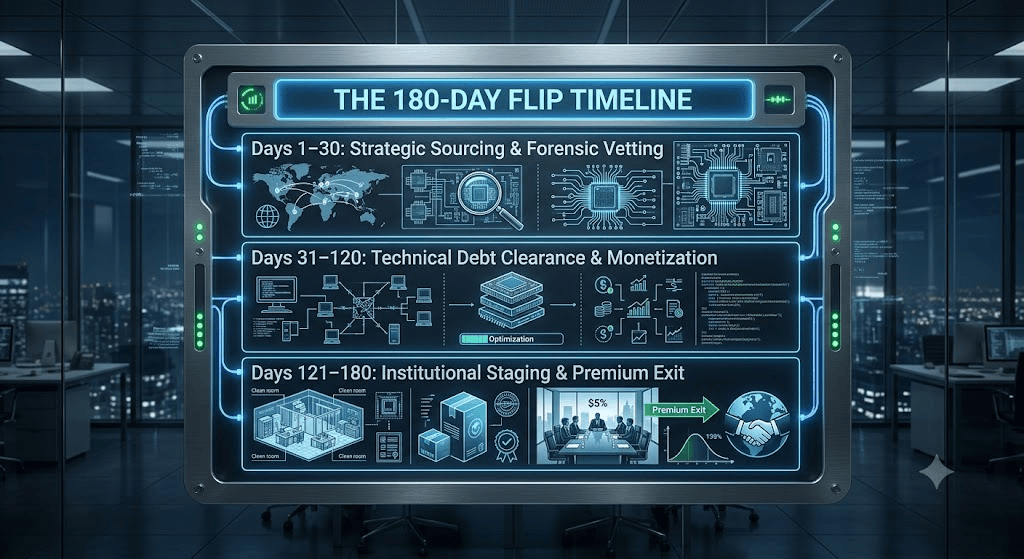
The 180-Day Capital Allocation Blueprint
1. Locate Under-Monetized Assets via Flippa: Sourcing Phase (Days 1–30).
Deploy targeted queries on Flippa using granular filters to locate properties with solid baseline organic traffic but low-yield monetization setups. Execute rigorous API-driven traffic and financial validation.
2. Clear Technical Debt and Optimize Infrastructure: Technical Re-Engineering (Days 31–60).
Migrate the acquired property to premium edge hosting, resolve all Core Web Vitals errors to secure immediate conversion boosts, and upgrade the display ad and affiliate network integrations to maximize yield per visitor.
3. Execute Content Pruning and Data Integration: Algorithmic Stabilization (Days 61–120).
Audit and refresh the legacy information architecture using advanced SEO optimization frameworks. Connect the asset’s live data pipelines to verified analytics suites to establish 90 days of clean, unassailable financial records.
4. Package Operational Systems and Close the Transaction: Capital Exit Phase (Days 121–180).
Compile all operational processes into comprehensive, turnkey SOP documents. List the asset back on premium secondary marketplaces, applying standard EBITDA add-back logic to maximize final valuation multiples and secure your 30% net profit.