
Investing in Classic Cars: 7 Hidden Costs You Must Know
In the high-stakes world of alternative investments, classic cars are often romanticized as “rolling art” that consistently outperforms the S&P 500. While iconic models like the Porsche 911 (996 generation) or the Nissan Skyline GT-R (R33) are projected by Hagerty to see value growth in 2026, gross appreciation often masks a series of aggressive carrying costs. To build a truly profitable automotive portfolio, an investor must look past the theatrical excitement of the auction hammer price and systematically account for the hidden financial drains that actively erode net yields.
Unlike public equities or specialized digital assets, vintage vehicles are highly complex, physical liabilities that require constant capital injections just to maintain a baseline valuation. If these expenses are not actively factored into your initial acquisition models, what appears to be a 15% annual gain on paper can easily manifest as a net loss in your bank account.
1. The “Climate Control” Premium
Unlike a modern vehicle built with robust, contemporary synthetic composites and highly corrosion-resistant alloys, a classic car is a structurally fragile asset. Storing a vintage machine, such as a 1969 Alfa Romeo GTV, in a standard unheated garage or a simple residential driveway is an absolute recipe for asset devaluation. Ambient moisture variation, unchecked humidity, and ambient temperature swings can lead to catastrophic body rust, frame rot, and irreversible interior dry rot within a single winter season.
To preserve the underlying asset equity, professional-grade, climate-controlled storage is not an optional luxury—it is a mandatory operational requirement. These specialized facilities use advanced commercial dehumidification systems to maintain a constant relative humidity of approximately 40% to 50% and a stable temperature of 68°F (20°C). This exact environmental equilibrium prevents the condensation that rusts bare metal and stops the ambient drying that splits vintage Connolly leather and wooden dashboards.
The Financial Trajectory of Specialized Storage
- The Cost: In the 2026 real estate landscape, high-security, climate-controlled vehicle storage spaces command anywhere from $300 to $1,200 per month, highly dependent on metropolitan density and premium facility amenities.
- The Math: If you anchor your vehicle in a mid-tier urban facility charging an average of $600 per month, the base holding cost scales rapidly:
$$\text{Annual Storage Cost} = \$600 \times 12 = \$7,200$$
$$\text{5-Year Storage Horizon} = \$7,200 \times 5 = \$36,000$$
Over a five-year investment horizon, storage alone can drain $18,000 to $72,000 per vehicle slot. This fixed overhead must be completely cleared by the vehicle’s gross market appreciation before you realize a single cent of actual investment profit.
2. “Agreed Value” Insurance Escalation
Standard automotive insurance policies operate under an “Actual Cash Value” (ACV) framework, which incorporates aggressive, automated depreciation tables. Utilizing a standard policy on a historical collector asset is a catastrophic mistake; in the event of a total loss, a conventional insurer will value a pristine collector piece as if it were simply a worn-out, high-mileage used car.
To mitigate this risk, serious investors must utilize specialized “Agreed Value” policies from dedicated underwriting providers like Hagerty, Grundy, or American Collectors Insurance. Under an Agreed Value contract, the owner and the underwriter come to a formal, legally binding agreement on the total written value of the vehicle before policy activation. If the asset is destroyed, the policy pays out that exact predetermined sum without any depreciation adjustments.
The 2026 Underwriting Shift
While collector car insurance is historically more affordable on a per-month basis than a conventional daily-driver policy, premiums for high-growth modern classics—such as the high-string BMW M5 (E60 generation) with its Formula 1-derived V10 engine—are experiencing upward rate adjustments in 2026. This upward trend is driven directly by the skyrocketing costs of specialized carbon fiber components and vintage electronic control units (ECUs).
Furthermore, these specialized policies carry highly restrictive operational parameters that investors frequently overlook:
- Mileage Caps: Policies typically enforce strict, audited driving limitations, usually capped at under 2,500 miles per year.
- Usage Constraints: Underwriters strictly forbid using the vehicle for regular grocery runs, daily workplace commuting, or school drop-offs.
- Prerequisite Vehicles: To qualify for a premium specialty policy, the investor must provide verifiable proof that every licensed driver in the household maintains a separate, modern daily-use vehicle for conventional transportation.
3. The Specialized Labor Gap
As the market progresses through 2026, the “Analog Era” performance cars from the late 1990s and early 2000s have cemented themselves as the highest-velocity segments of the collector market. However, these vehicles sit at a difficult technological crossroads: they are old enough to suffer from component degradation, yet complex enough to require advanced electronic diagnostics and proprietary tools that conventional local mechanics simply do not possess.
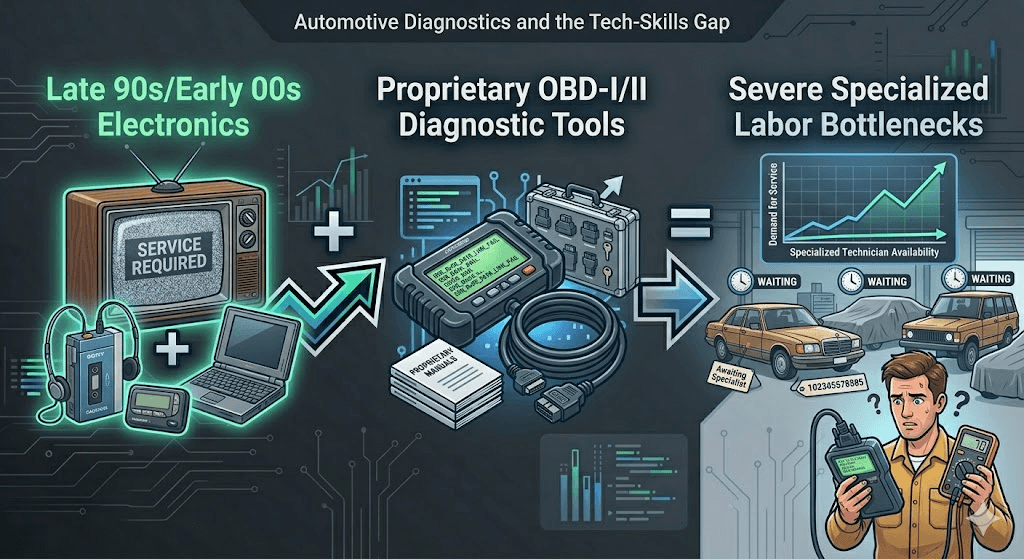
A basic annual fluid and filter service for a complex exotic like a Lamborghini Aventador or a Ferrari 599 GTB can easily command between $6,000 and $10,000 at a factory-authorized service center. Even if you shift your focus to highly “attainable” entry-level classics like a second-generation Mazda MX-5 Miata (NB), you are bound to face significant inflationary pressure.
Original Equipment Manufacturer (OEM) factory parts are quickly going out of print, forcing reliance on expensive custom fabricators. Concurrently, the labor rates for certified vintage marque specialists have climbed past $200+ per hour in 2026 due to an acute shortage of younger technicians trained in the nuances of mechanical fuel injection, carburetors, and early digital engine management systems.
4. Acquisition and Transport Friction
Acquiring a blue-chip vehicle through an elite collector ecosystem like a Barrett-Jackson, RM Sotheby’s, or Broad Arrow auction involves massive frictional transaction fees that never appear in the initial headline numbers broadcast to the public.
The Buyer’s Premium
When you wave your paddle and win an asset at a live auction, you do not simply pay the final number established by the auctioneer’s hammer. You are structurally obligated to pay an additional Buyer’s Premium, which universally ranges from 10% to 12% of the final hammer price. For example, if you successfully bid $200,000 on a vintage muscle car, your actual invoice from the auction house will look like this:
Invoice Amount = $200,000 + $200,000 \times 0.12 = $224,000$$
Protected Logistical Logistics
Once the financial transaction settles, you cannot simply drive a pristine asset home across multiple state lines and risk road debris or weather damage. Moving an investment-grade vehicle, such as a low-mileage 2006 Chevrolet Corvette Z06, requires specialized, closed-container logistics.
Hiring a dual-axle, weather-protected, climate-controlled car hauler to transport your asset across the country routinely costs between $1,500 and $3,500. When you combine the auction house transaction fees, specialized transport logistics, and immediate state registration taxes, these entry-and-exit frictions frequently put your new asset 15% in the red from day one.
5. The “Use It or Lose It” Depreciation
Mechanical assets suffer aggressively from a phenomenon known as “mechanical atrophy.” Unlike a stock certificate or a gold bar that sits passively inside a vault without structural degradation, a classic car is a complex machine consisting of hundreds of moving parts, rubber seals, and volatile fluids designed explicitly to run.
If you park an iconic vehicle, like a classic Continental Mark II, in a static display for years on end to artificially keep the odometer frozen, a silent internal countdown begins:
- Seal Degradation: Without oil circulation, internal engine, transmission, and differential seals dry out, shrink, and begin to leak profusely once the car is finally started.
- Fuel Varnish: Modern ethanol-blended pump fuels break down rapidly, leaving thick, sticky varnish deposits throughout fuel lines, injectors, and carburetors.
- Tire Flat-Spotting: Under the static weight of the vehicle, tires develop permanent flat spots along their contact patches, destroying the structural integrity of the rubber compounds and requiring total replacement.
The Maintenance Paradox
To preserve your vehicle’s mechanical health, you are caught in a difficult operational paradox: you must drive the car occasionally to keep the fluids moving and the seals lubricated. However, exceeding highly specific odometer milestones can completely erase value. For example, allowing a hypercar like a Porsche Carrera GT to cross the 10,000-mile threshold strips away its status as a “low-mileage survivor,” instantly triggering a $100,000+ reduction in open-market valuation.
6. Documentation and “Provenance” Audits
In the 2026 collector vehicle market, a classic car lacking comprehensive, verified physical documentation is a massive financial liability. Because the market has seen an influx of highly sophisticated counterfeit clones—such as basic standard models modified to look like ultra-rare factory performance variants—buyers are demanding ironclad, forensic proof of authenticity.
Investors must demand a complete, unbroken “paper trail,” including:
- Original factory build sheets are found under the carpets or behind dashboards.
- The initial dealership window sticker showed all factory-installed options.
- Unbroken, chronological physical service books carrying official dealer stamps.
- Detailed receipts spanning multiple decades to account for every mechanical repair.
The Financial Hit of Missing Records
Missing or incomplete historical documentation can instantly slash a vehicle’s potential resale value by 20% or more. To protect yourself against buying a fraudulent vehicle, you must proactively hire an independent, marque-specific expert to execute a formal “matching numbers” inspection. This process involves physically auditing the unique factory stampings on the engine block, transmission casing, and chassis structure to verify that the components currently in the vehicle are the same items installed on the assembly line decades ago. These specialist inspections routinely cost between $500 and $2,000 per vehicle, representing an unavoidable upfront due diligence expense.
7. Opportunity Cost and Liquidity
Unlike traditional public equities, where you can instantly liquidate a position in Apple (AAPL) or an index fund with a single click on a mobile application, classic cars are highly illiquid assets. They operate in a fragmented, highly inefficient, sentiment-driven market environment.
The Exit Risk and Time Horizon
When you decide it is time to capture profits and exit a position, finding a qualified collector-buyer who has the specific liquid capital and the exact taste for your specific vehicle configuration typically takes 3 to 6 months. Throughout this extended sales window, your capital remains completely locked up, unable to earn yield elsewhere, while you are forced to keep paying your fixed monthly storage, maintenance, and insurance bills.
If a sudden macroeconomic liquidity squeeze occurs and you require immediate cash, you will be forced to take one of two financially damaging routes: either sell the asset to a professional wholesale dealer at a steep 20% to 30% haircut, or submit the vehicle to a public auction with a “No Reserve” structure, leaving your final payout completely exposed to whatever the room happens to feel like bidding that afternoon.
2. Dynamic Performance Matrix
To visually map the structural divergence between gross value and net holding costs, review this detailed cross-section of investment-grade models in the 2026 collector ecosystem:
| Vehicle Class | 2026 Estimated Market Value (Cond. 2 Excellent) | Annual Fixed Carrying Cost (Est. Storage, Ins, Base Maintenance) | Realized Net Yield Impact (Year 1) |
| Volkswagen Golf GTI VR6 (Mk3, 1995-1998) | $20,000 | $2,500 | −12.5% Gross Drag |
| Dodge Charger (Classic Muscle, 1968-1970) | $91,450 | $5,000 | −5.4% Gross Drag |
| Porsche Carrera GT (Hypercar, 2004-2007) | $1,550,000 | $25,000+ | −1.6% Gross Drag |
Strategic Takeaway: The lower the initial purchase price of the classic vehicle, the more aggressively the fixed carrying costs will eat into your total percentage yield. Buying an “affordable” $20,000 classic means your annual storage and maintenance costs act as a massive 12.5% drag on your position, making capital growth incredibly difficult to realize compared to a million-dollar hyper-car.
3. Diversifying Beyond Illiquid Automotive Overhead
When you calculate the sheer physical friction, real estate costs, and labor bottlenecks associated with managing a fleet of physical classic cars, it becomes clear why institutional managers limit their exposure to physical alternative goods. For an alternative asset portfolio to scale efficiently, it must be balanced with highly liquid hard assets that completely decouple your wealth from physical storage drag and maintenance inflation.
If your investment goal is to capture value from tangible, appreciating, finite physical goods without the operational headaches of car logistics, the institutional method is to pivot a portion of your capital into high-grade, bulk maturing wholesale commodities. The premier venue for executing this strategy is WhiskyInvestDirect.
The Efficiency of Wholesale Maturing Whisky
Rather than storing multi-ton steel machines that degrade when left static, WhiskyInvestDirect allows you to buy and hold a physical commodity that mathematically improves in quality and open-market value simply by sitting completely still: premium Scotch whisky maturing inside its original oak casks within government-bonded warehouses in Scotland.
[Distillation / Low Price] ➔ [Passive Barrel Maturation] ➔ [Aged Commodity Premium Sale]
As the spirit matures over 3, 5, 8, or 12 years, it undergoes organic barrel maturation, transforming from raw spirit into a highly valuable component required by global blending houses to sustain their commercial brands. You purchase the asset at pure wholesale pricing by the Litre of Pure Alcohol (LPA) and hold it in a secure environment completely free from the physical labor shortages or part scarcities that plague the automotive world.
Frictional Drag Comparison: Classic Cars vs. WhiskyInvestDirect
To see exactly how physical automotive overhead stacks up against a streamlined alternative commodity platform, analyze the structural fees side-by-side:
| Operational Expense Category | Classic Automotive Portfolio | WhiskyInvestDirect Platform Architecture |
| Upfront Entry Friction | 10% – 12% Auction Buyer’s Premium + Cross-Country Transport Costs. | A flat 1.75% Trading Commission on all live order board executions. |
| Ongoing Maintenance & Upkeep | Variable specialist labor rates at $200+/hour; unpredictable parts replacement. | Zero maintenance required. The asset improves chemically over time in passive storage. |
| Storage & Insurance Overhead | $300 to $1,200 per month per vehicle slot ($3,600 – $14,400 annually). | £0.227 per Litre of Pure Alcohol (LPA) per year (including full warehouse insurance). |
| Exit Settlement Velocity | 3 to 6 months to secure a retail buyer or match an auction schedule. | Instantaneous liquidity via an open, 24/7 online wholesale order board. |
By utilizing WhiskyInvestDirect, you can allocate capital directly to a physically appreciating, finite hard asset while keeping your ongoing storage and insurance costs scaled to a fraction of a percent. This enables your capital to compound cleanly without being eaten alive by transport logistics, specialist garage bills, or auction house premiums.
FAQ
Is it better to buy a “Project” or a “Pristine” car?
In the 2026 economic environment, restoration costs for expert metal fabrication, professional paintwork, and specialized mechanical reconstruction have drastically outpaced the ultimate open-market resale value of almost all mid-tier collector cars. If you buy a degraded “project car” for $10,000, you can easily sink $50,000 worth of specialized parts and high-dollar labor into it, only to end up with a vehicle that possesses a maximum market value of $35,000. It is almost universally more cost-effective to pay a premium upfront for a pristine, turn-key vehicle where a previous owner has already absorbed the financial damage of restoration.
Do modern EVs impact classic car values?
The global Electric Classic Car Market is experiencing rapid expansion and is projected by market research analysts to reach a total valuation of $12.4 billion by 2033. This growth is fueled by a segment of wealthy urban collectors who are executing “EV-swaps”—retrofitting classic body shells with modern electric drivetrains—to maintain legal usability within strictly regulated, urban low-emission zones across major European and metropolitan centers. However, this trend cuts both ways: while an EV conversion significantly boosts a car’s daily usability, it destroys the historical purity of the vehicle, resulting in a severe, permanent reduction in value for ultra-rare, “matching numbers” exotic collector pieces.
What is the “Hagerty Hundred”?
The Hagerty Hundred is a highly respected, data-driven market index that tracks the weighted average value of the 100 most commonly insured classic and collector vehicles in the global market. It functions as a broad barometer for the mass-market collector car space. Moving through the early months of 2026, the index has experienced a clear inflationary correction and currently hovers around over $43,000. This baseline performance indicates a notable stabilization and softening in the broad, everyday enthusiast segment of the market, whereas the ultra-high-end, blue-chip exotic tier ($1,000,000+) remains insulated and historically resilient.
How do I verify a car’s history?
For modern classics manufactured from 1981 onward, you can easily use digital services like Carfax or AutoCheck to pull automated title records, registration timelines, and documented accident reports via the standardized 17-digit Vehicle Identification Number (VIN). However, for older vintage vehicles, these digital registries do not exist. You must manually contact marque-specific owner clubs (such as the Ferrari Club of America, the Porsche Club of America, or the Shelby American Automobile Club) to obtain access to specialized, privately maintained chassis registries, historical factory archives, and verified ownership records.
Can I use a 401(k) to buy a classic car?
You cannot directly hold a physical vehicle inside a conventional corporate 401(k) or standard personal IRA; the Internal Revenue Service strictly classifies physical motor vehicles as “collectibles” and treats any attempt to purchase them with standard retirement funds as a highly penalized, immediate taxable distribution. Some advanced investors bypass this limitation by establishing a specialized Self-Directed IRA (SDIRA) that uses a dedicated LLC structure to hold alternative assets. However, the legal compliance rules are incredibly unforgiving: the SDIRA entity must hold absolute title to the car, it must be stored in a commercial third-party facility completely separate from your personal property, and you are strictly prohibited from driving the vehicle even a single mile for personal enjoyment.
Final Portfolio Framework
To scale your alternative investment portfolio into a resilient financial enterprise in 2026, you must completely separate personal automotive passion from calculated asset management. Classic cars can provide impressive returns, but only if you aggressively build their carrying costs directly into your financial projections from the very beginning.
By keeping your physical automotive exposure limited to ultra-rare, high-conviction models where appreciation mathematically outpaces storage drag, and balancing that exposure with highly liquid, zero-overhead alternative commodities via WhiskyInvestDirect, you protect your capital from unnecessary operational leakages. Diversify your risk, mitigate maintenance overhead, track demographic spending shifts, and ensure your alternative assets are working efficiently for your net worth.