

Collectibles Investing: What Actually Holds Value
Collectibles have fully transitioned from casual, nostalgia-driven hobbies into a recognized, institutionalized alternative asset class. Volatility in public equities and real estate has forced capital into tangible, uncorrelated markets. The global collectibles market is projected to grow from its 2025 base to reach approximately $469.9 billion by 2032, expanding at a highly steady and predictable compound annual growth rate (CAGR) of 5.5%. For an “Empire Builder” looking to construct a multi-generational asset portfolio, the objective is straightforward yet mechanically complex: identify highly specific items where acute, mathematical scarcity intersects with long-term cultural longevity.
Unlike public stocks, corporate bonds, or mutual funds, collectibles are completely “non-fungible.” Every single asset is unique. Two copies of the same item are not interchangeable; their value is fiercely tied to three core vectors: physical condition (micro-level preservation), ironclad provenance (documented ownership history), and macrohistorical significance. Navigating this landscape requires moving beyond pure aesthetic appreciation and understanding the underlying mechanics of supply, grading, liquidity pools, and platform ecosystems.
1. High-Value Asset Classes for 2026
The contemporary collector-investor cannot afford to buy broadly. In 2026, the market has undergone a severe flight to quality, splitting into highly distinct verticals. The following categories have demonstrated the highest historical resilience, structural liquidity, and compound growth potential.
Trading Cards (TCGs & Sports)
Trading cards remain the uncontested “King of the Hill” in the alternative asset world. This segment operates like a high-velocity stock exchange, with trading volume eclipsing almost all other collectible verticals. Within Trading Card Games (TCGs), the market is anchored by iconic intellectual properties that possess generational staying power. Vintage Pokémon cards—specifically Gem-Mint, first-edition base set Charizards—and foundational Magic: The Gathering assets like the legendary Alpha/Beta Black Lotus function as the “blue-chip equities” of this space.
Concurrently, high-grade vintage and modern sports cards featuring transcendent athletes such as Michael Jordan, LeBron James, Tom Brady, or Erling Haaland continue to set massive auction records. Value here is entirely binary: a raw, ungraded card commands a fraction of the value of a card locked in a museum-grade holder with a verified pristine rating.
Designer Toys & “Newstalgia”
The fastest-growing segment in the 2026 collectibles landscape is the modern toy and action figure sector, powered by a massive wave of “Newstalgia.” This phenomenon is driven by the shifting purchasing power of Millennials and Gen Z, who are now entering their peak earning years and aggressively buying back their childhood memories.
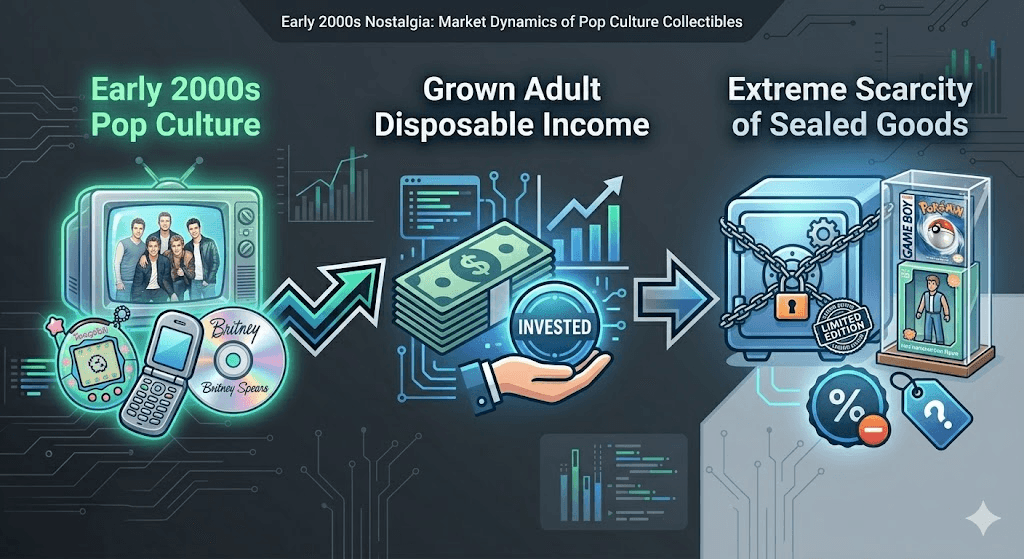
Rare, vaulted Funko Pops, highly limited Medicom BE@RBRICK figures, and factory-sealed LEGO sets from the late 1990s and early 2000s (particularly licensed Star Wars, Harry Potter, and classic Creator sets) are systematically outperforming traditional equities and precious metals over multi-year horizons. The core investment thesis relies on the permanent destruction of supply. As children opened and destroyed these items decades ago, the remaining population of pristine, factory-sealed products shrinks toward absolute zero.
Fine Art & Contemporary Artists
The fine art market in 2026 is experiencing a profound structural “re-centring.” While traditional Old Masters and mid-century modern titans maintain stable baselines, hyper-growth capital is flooding into contemporary sectors, with an analytical focus on female and South Asian artists.
Collectors and institutional funds are targeting creators like Claire Tabouret and Hiba Schahbaz. These artists are seeing their primary and secondary market values climb due to heavy institutional exposure, major museum acquisitions, and critical academic acclaim. Investing in this vertical requires deep structural awareness of gallery representation, exhibition histories, and primary-to-secondary market price mechanics.
Alternative Luxury (Watches & Wine)
Independent horology and liquid assets remain the premier hedge against fiat currency debasement for high-net-worth portfolios. In the horological sector, collectors have shifted focus away from mass-produced luxury giants and toward hyper-scarce, independent watchmakers such as F.P. Journe, Philippe Dufour, and Rexhep Rexhepi. These master watchmakers produce fewer than a few hundred pieces annually, creating a permanent supply-demand mismatch.
Simultaneously, “Blue Chip” investment-grade wines from the Bordeaux, Burgundy, and Tuscany regions serve as ultra-stable portfolio anchors. Because these assets are consumed over time, the physical supply of a specific vintage mathematically diminishes each year, driving prices upward as the wine reaches its peak drinking maturity.
2. Top Marketplaces for 2026
To successfully scale a collectible investment portfolio into a legitimate business enterprise, you must utilize highly specialized transactional platforms. These environments must offer deep capital pools, high liquidity, and absolute verification mechanisms to mitigate counterparty risk.
| Category | Recommended Platforms (2026) | Strategic Specialization & Best For |
| General & Antiques | Catawiki, eBay | Global retail reach, high transaction velocity, and expert-reviewed weekly auctions. |
| Trading Cards | Heritage Auctions, Goldin | Ultra-high-end rare cards, historic sports memorabilia, and six-figure asset liquidity. |
| Fine Art | Artsy, Sotheby’s | Primary market discovery of emerging contemporary talent and blue-chip secondary sales. |
| SaaS & Digital Assets | Dapper Labs, OpenSea | Digital native collectibles, curated NFT infrastructure, and blue-chip communities (BAYC, Flow). |
| Vintage Toys & Culture | Back to the Past, StockX | Anonymized, fully verified data-driven trading of action figures, sneakers, and diecast cars. |
3. The Rise of Fractional Investment
One of the most revolutionary structural shifts in the modern asset landscape is the democratization of high-barrier collectibles. You no longer require $100,000 to $1,000,000 in liquid capital to acquire an allocation in a world-class masterpiece or a historic asset. Fractionalization platforms act as specialized financial intermediaries: they source the asset, arrange for legal custody, manage insurance protocols, split the underlying equity into accessible shares, and eventually execute an exit sale to return capital to investors.
- Masterworks: The undisputed market leader for fractional fine art. Masterworks registers multi-million dollar paintings by artists like Banksy, Picasso, and Basquiat with the SEC as individual mini-corporations. Regular investors can purchase shares for minimums as low as $1,000, gaining direct exposure to the historical appreciation of top-tier art without the logistical burden of climate-controlled physical storage.
- Public.com: A highly versatile multi-asset platform that allows fractional investing in premium physical culture. Users can buy slices of rare comic books (e.g., Action Comics #1), pristine vintage sneakers, and high-end trading cards directly alongside their traditional index funds and equities, consolidating their portfolio view into a single digital interface.
- Investables (UK): A prominent startup focused on highly vetted, rare cultural collections. Investables bridges the gap between traditional finance and web3 architecture, allowing users to acquire fractional shares in physical collectibles using standard bank wires or verified cryptocurrency rails.
- Yieldstreet: Positioned primarily for accredited investors and institutional-lite portfolios, Yieldstreet incorporates high-end collectibles into diversified alternative income funds. This allows investors to gain exposure to art equity, collector car portfolios, and luxury debt instruments within a broader alternative investment framework.
4. Critical Drivers of Value
In 2026, asset valuation in the collectibles sector has completely moved away from subjective guesswork. It relies on three rigid, objective pillars that determine whether an asset will compound in value or suffer from permanent capital loss.
Professional Third-Party Grading
The modern collectibles market is entirely unforgiving toward uncertified assets. A raw, ungraded sports card or comic book is plagued by asymmetric information; buyers assume the worst regarding its physical condition.
The standardization of third-party authentication services has completely resolved this issue through “slabbing”—permanently sealing an item in a sonically welded, tamper-proof acrylic case with an assigned numerical grade from 1 to 10.
The Grading Premium Example: An un-graded, raw 1999 Pokémon Base Set Unlimited Charizard card may command a market price of roughly $200 to $400 due to hidden wear. The exact same card, submitted to PSA (Professional Sports Authenticator) and returning a flawless PSA 10 Gem-Mint grade, can easily command upwards of $10,000 to $15,000 at public auction.
For comic books, CGC (Certified Guarantor Company) provides identical market standardization, making physical grading a mandatory prerequisite for any serious capital allocation.
Cultural Resilience & Demographics
Value in alternative assets does not exist in an economic vacuum; it is directly tied to the aggregate disposable income of the specific generation currently occupying their peak earning years. In 2026, a massive demographic transition is occurring. The purchasing power of Baby Boomers is declining as they draw down assets, while Gen X, Millennials, and elder Gen Z individuals are dominating the buy-side of the market.
Consequently, traditional 18th-century mahogany furniture, 1950s porcelain dolls, and silver tea sets are experiencing severe structural deflation. Conversely, assets from the 1990s and 2000s—the cultural touchstones of the internet generation—are experiencing intense capital inflows. An investor must always look forward: invest in the childhood nostalgia of the people who will have the most money ten to twenty years from now.
Ironclad Provenance & Chain of Custody
Provenance is the documented history of an item’s ownership from the moment of its creation or initial release down to the present day. Without it, a high-value asset like a fine art canvas or a game-worn jersey faces intense skepticism regarding its legitimacy.
In 2026, the gold standard for provenance verification involves matching physical items with digital cryptographic receipts. Platforms are increasingly using public blockchains to mint Non-Fungible Tokens (NFTs) that act as immutable, digital twins to physical goods. When ownership of the physical asset transfers, the digital token transfers along with it, creating an unfalsifiable, transparent record of custody that eliminates counterfeiting and drastically reduces transaction friction.
5. Strategic Expansion: Alternative Commodity Hard Assets
For an alternative asset portfolio to be truly resilient, it cannot rely entirely on pop culture or shifting consumer tastes. True diversification requires adding an asset class rooted in tangible, physical maturation—where time itself acts as the primary driver of value. This is where wholesale commodity investing, specifically premium maturing Scotch whisky, enters the equation.
While buying individual bottles of rare whisky at retail is subject to fashion trends and counterfeit risks, investing in the raw, bulk commodity—maturing spirit still inside the original distillery cask—offers a completely different economic profile. As the spirit sits in a customs-bonded warehouse in Scotland, it undergoes an irreversible chemical reaction with the wood, improving in quality, depth, and market value. A 3-year-old single malt is fundamentally a completely different, lower-priced commodity than a highly coveted 12- or 18-year-old single malt.
Historically, private individuals were completely locked out of this wholesale market, which was restricted entirely to major multi-national distillers and blenders. Today, the institutional way to play this market is through WhiskyInvestDirect.
The Mechanics of Wholesale Cask Investing
WhiskyInvestDirect operates an open, live order board that allows investors to buy and sell maturing Scotch whisky in bulk volumes—measured by Litres of Pure Alcohol (LPA)—directly inside secure, government-bonded warehouses. You are buying the actual physical inventory at wholesale prices when it is at its absolute cheapest (just after distillation), holding it passively as it matures, and eventually selling it back to the big blending houses, which require aged stock to create their global commercial brands.
Understanding the Cost Structure
To maintain a profitable alternative commodity operation, you must evaluate the carrying costs with extreme precision. WhiskyInvestDirect utilizes a remarkably transparent, low-drag tariff structure designed for institutional-grade portfolios:
- Trading Commission: A flat 1.75% fee is applied each time you execute a buy or sell order on the live order board.
- Storage & Insurance: Maturing spirits require continuous care, physical security, and comprehensive insurance against fire or loss. The platform charges £0.227 per Litre of Pure Alcohol (LPA) per year. This fee is accrued daily and billed monthly, subject to a small account minimum of £3 per month.
- Currency Optimization: While fees are benchmarked in British Pounds (the native currency of Scotch whisky), accounts can be completely funded and managed in US Dollars or Euros, with cross-currency settlement executed at the exact mid-point spot price without any arbitrary buy-sell spreads.
By shifting a portion of your collectibles allocation into a structurally appreciating physical commodity via WhiskyInvestDirect, you effectively decouple a percentage of your wealth from pop-culture trends, anchoring it instead to global consumer demand for premium aged spirits.
FAQ
What is the “10% Rule” for collectibles?
The 10% Rule is a foundational portfolio construction guide used by wealth managers. Because collectibles are fundamentally illiquid, produce zero cash flow (no natural dividends or yield), and carry high transactional frictions, you should never allocate more than 5% to 10% of your total investable net worth to this asset class. The remaining 90% should always reside in liquid, productive core assets like equities, debt instruments, and cash reserves.
Is LEGO a better investment than gold?
Historically, yes. Academic studies examining asset returns between 1987 and 2015 revealed that retired, pristine LEGO sets generated an average real return of roughly 11% annually, outperforming gold, major fiat currencies, and large-cap stock indices during several distinct macroeconomic downturns. In the 2026 market, the highest yielding sets are those tied to massive, multi-generational licensed properties (such as Star Wars Ultimate Collector Series or Harry Potter Hogwarts castles) that retain a global fan base.
How do I avoid fakes?
The only way to completely insulate your capital from counterfeits is to strictly buy items that are “Slabbed”—permanently authenticated and sealed in a hard acrylic shell by a top-tier independent grading company (like PSA, BGS, or CGC). If you are acquiring high-value art or luxury items that cannot be slabbed, you must insist on a comprehensive paper trail of Provenance or a verified Certificate of Authenticity (COA) issued directly by an elite, Tier-1 auction house like Christie’s, Sotheby’s, or Phillips.
What is “Impermanent Loss” in digital collectibles?
Impermanent Loss is a major risk metric within decentralized web3 ecosystems. If you deposit digital collectibles or NFTs into an automated market maker (AMM) liquidity pool to earn transaction fees, and the open-market price of that specific collectible drops sharply relative to the pool’s base crypto asset (like ETH or FLOW), the protocol’s rebalancing math will automatically convert your position. You can easily end up with a collection of lower-value digital assets, resulting in less total net worth than if you had simply held the raw cryptocurrency in a cold-storage wallet.
Are there taxes on collectible gains?
Yes. In the vast majority of developed financial jurisdictions, collectibles are classified as luxury alternative assets and do not qualify for preferential lower capital gains tax brackets. For example, within the United States, net profits realized from the sale of collectibles are taxed at a distinct maximum long-term capital gains rate of 28%, which is significantly higher than the standard 15% or 20% tax rates applied to traditional long-term stock and exchange-traded fund (ETF) profits.
Conclusion: Designing a 2026 Alternative Portfolio
Collectibles are no longer just an eccentric pursuit for passionate hobbyists; they represent a highly sophisticated, multi-billion-dollar frontier for alternative asset allocation. To build a true alternative empire in 2026, you must completely strip away personal emotional attachments and look at items through a purely quantitative lens.
By balancing hyper-scarce cultural assets like graded trading cards or contemporary art with structurally maturing physical commodities like wholesale Scotch whisky via WhiskyInvestDirect, you can construct a resilient, uncorrelated portfolio designed to compound value regardless of macroeconomic volatility. The strategy is clear: trust professional grading, track generational demographic spending shifts, minimize transactional drag, and always maintain an extended investment horizon.