

Are Content Sites the Best Cash-Flow Businesses in 2026?
The long-standing allure of the content site as a frictionless, “passive” cash-flow engine has faced its most rigorous structural test in 2026. For over a decade, the foundational blueprint for digital media ownership was extraordinarily straightforward: identify low-competition keywords, publish high-volume informational text, place a programmatic ad script on the page, and collect recurring checks from Google AdSense.
In the current macroeconomic environment, that legacy volume game has officially collapsed. Driven by the commoditization of generative AI tools and consecutive search algorithm overhauls, the market has pivoted. Today, high-performing content sites are treated not as simple blogs, but as high-yield digital media assets. The primary operational mandate has shifted from accumulating raw, anonymous traffic to the targeted acquisition of high-intent, converting audiences.
Despite this paradigm shift, content sites remain among the absolute best cash-flow businesses available to modern portfolio managers, consistently sustaining incredible 80% to 90% net margins. However, the barrier to entry has moved decisively away from pure content production and anchored itself entirely in institutional authority and proprietary data control.
1. The AI Bifurcation: Navigating Search Overviews (SGE)
The widespread deployment of generative AI Search Overviews across major engines has completely bifurcated the digital discovery marketplace. Understanding this layout transformation is critical for accurate capital deployment:
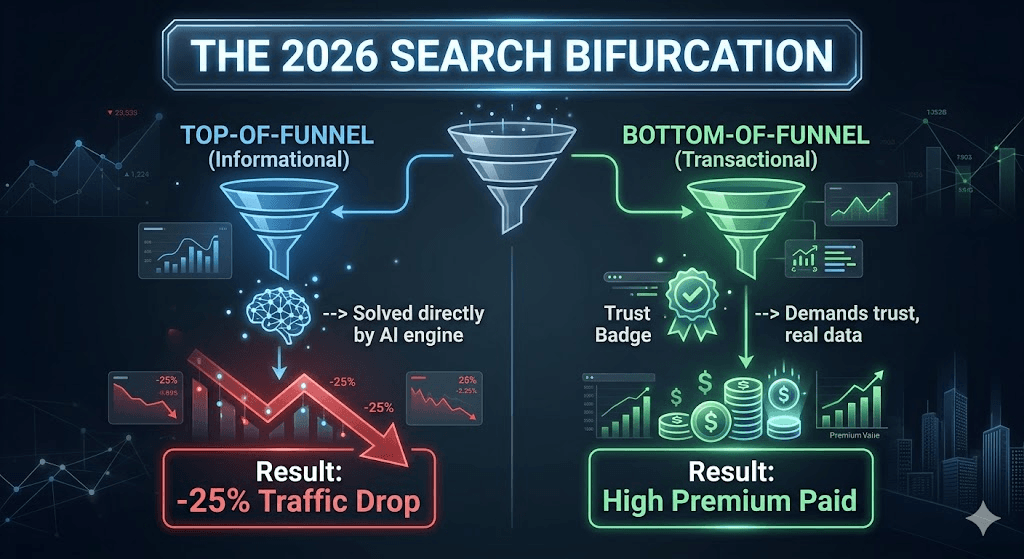
Informational, top-of-funnel queries (e.g., “What is a corporate bond?”) no longer route significant click volume to external destinations; AI interfaces answer these definitions directly on the primary results page. Data from early 2026 confirms that generic informational traffic plummeted by roughly 25% across non-branded media assets.
Conversely, bottom-of-funnel transactional queries—where a user is actively searching for specialized execution strategies, software comparisons, or high-ticket service provider recommendations—have seen a massive surge in valuation. Search engines now heavily prioritize assets displaying uncompromising E-E-A-T (Experience, Expertise, Authoritativeness, and Trustworthiness).
In 2026, the ultimate competitive advantage is securing placement as a cited, hyperlinked verification source within the AI-generated response layout itself. Sites that provide primary data, real-world case studies, and expert human synthesis command an immense premium because they capture the user at the exact moment of commercial intent.
2. The High-Ticket Affiliate Evolution
As generic programmatic display ad rates encounter margin pressure, affiliate monetization has evolved into a highly profitable, enterprise-focused engine. The broader market continues to expand rapidly, with domestic performance-marketing spend projected to scale past $12.4 billion this year.
Sophisticated digital asset operators have abandoned low-tier consumer goods networks that offer fragile 3% commissions on physical products. Instead, capital is deployed toward securing high-margin, recurring affiliate partnerships within B2B software (SaaS), FinTech, and enterprise services.
| Niche Class | Monetization Style | Target Commission Structure | Average Lead Value (LV) |
| B2B SaaS / CRM | High-Ticket Recurring | 20% – 50% Lifetime Monthly ARR | $150+ per conversion |
| Corporate Fintech | Flat-Fee Acquisition | $200 – $500 per approved account | $350+ per customer |
| Enterprise Services | Lead Arbitrage | Variable percentage of closed contract | $500+ per validated lead |
Consider the unit economics of a specialized asset ranking for a commercially dense term such as “Best AI-Driven CRM for Real Estate Teams.” Rather than needing millions of pageviews to generate nominal display ad returns, this single highly targeted asset operates as an automated digital salesperson. Because the user intent is hyper-specific, a modest but deeply qualified stream of monthly visitors can generate thousands in high-ticket recurring cash flow at a fraction of the bandwidth costs required by legacy viral media sites.
3. Valuations & Asset Acquisition: The Buy vs. Build Calculation
The mergers and acquisitions (M&A) ecosystem for digital media properties has reached full maturity, presenting a major capital allocation choice for modern investors:
The Valuation Correction
Valuation multiples have undergone an institutional healthy correction over the past 24 months, normalizing from the over-inflated, aggregator-driven peaks of 2021-2022 (which frequently saw sites priced at 35x to 45x+ monthly earnings).
According to data tracking transaction metrics across premier marketplaces, current baseline multiples for premium digital media assets sit comfortably between 24x and 30x monthly net profit. While upfront cash allocations at the closing table have dropped slightly to protect buyers against algorithmic transitions, the yields available to incoming operators are historically high.
The Macro Tracking Matrix
| Metric Lens | Legacy Average | 2026 Market Standard | Investor Impact |
| Average Monthly Multiple | 27x – 35x | 24x – 30x | Lower entry pricing; higher immediate cash yield |
| Upfront Cash at Close | 90% | 82% – 87% | Increased downside protection via seller notes/holdbacks |
| SaaS Affiliate Net ROI | 15% – 20% | 25% – 40% | Accelerated capital recovery timelines via optimized funnels |
Bypassing the Sandbox: The Case for Acquisition
For investors deploying capital with a minimum threshold of $50,000, building a digital media asset from a blank domain has become highly inefficient. Search engines now subject new domains to an extended “trust-building sandbox” phase that routinely lasts 12 to 18 months, during which organic visibility is strictly capped regardless of content quality.
By leveraging marketplaces like Flippa, acquisition entrepreneurs can safely bypass this non-earning window. Purchasing an established, cash-flowing asset that already possesses an authenticated backlink profile and a stable baseline of 50,000+ monthly visitors unlocks immediate operational leverage. The investor can immediately skip the discovery phase and implement Conversion Rate Optimization (CRO) frameworks to expand margins from Day 1.
4. Maximizing Yield via the “Backend Offer.”
In the contemporary retail asset framework, programmatic ad revenue and baseline affiliate payouts are no longer viewed as the ultimate goal—they represent the absolute floor of an asset’s valuation. The true enterprise value is unlocked by treating the content site as a foundational infrastructure engine designed to fuel high-margin backend offers.
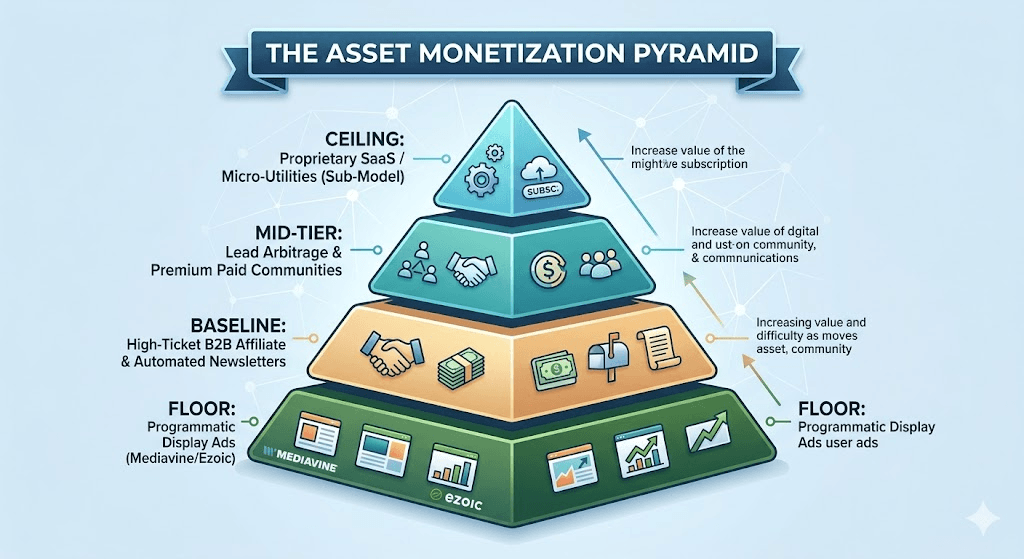
Premium Paid Newsletters
Transitioning organic web traffic into a dedicated, owned ecosystem is the ultimate hedge against external platform changes. By deploying incentivized opt-in funnels, operators can convert casual search engine visitors into structured subscribers, charging a recurring premium (e.g., $20 to $50/month) for deeper asset analysis, proprietary datasets, or real-time market alerts.
High-Margin Lead Arbitrage
Instead of routing high-intent buyers to external affiliate networks for a nominal percentage, advanced operators sell validated buyer data directly to regional service providers, mortgage brokers, or insurance operations. A highly focused niche site can command anywhere from $50 to $200+ per qualified lead from local firms eager to capture data-verified customers.
Proprietary Micro-SaaS Integrations
The highest tier of modern monetization involves embedding custom interactive utilities—such as advanced calculators, comparison engines, or workflow trackers—directly into the high-traffic hubs of the site. Locking these premium tools behind a low-cost software subscription transforms traditional content traffic into highly valuable recurring SaaS revenue.
The First-Party Data Mandate: In the current digital landscape, a web property generating 100,000 monthly visitors without a central data capture mechanism is an extremely fragile asset. Conversely, a highly specialized brand generating only 20,000 visitors but capturing a 10,000-person active, verified newsletter audience represents a resilient, highly defensible business that will consistently command premium valuation multiples upon eventual resale.
FAQ: Deep Operational Insights
Why are transaction multiples lower now than during the 2022 peak?
The market has executed a necessary correction to account for “AI-risk” and platform algorithmic shifts. Sophisticated buyers now require higher immediate cash-on-cash yields to offset the risk of platform volatility, effectively shifting the leverage back to disciplined acquisition entrepreneurs.
Is it structurally safer to build from scratch or buy on an open marketplace?
Acquiring an asset via an open platform like Flippa is overwhelmingly safer for capitalized investors. It provides immediate, verifiable historical data proof, established indexing positions, and existing cash flow, eliminating the 12-to-18-month unmonetized sandbox phase inherent to fresh domains.
Can programmatic AI-assisted content still rank effectively?
Yes, but only under strict human-in-the-loop editorial governance. Algorithms easily identify and penalize generic, automated text regurgitation. Content must be heavily upgraded to include original human perspective, proprietary photography, real-world case studies, and transparent author data to pass E-E-A-T testing.
What specific niches command the highest enterprise multiples on exit?
B2B SaaS, Professional Corporate Finance, Health and Longevity tech, and Deep Industrial B2B infrastructure. These sectors feature the highest cost-per-click (CPC) values in advertising and support the most lucrative backend conversion offers.
The Acquisition & Optimization Blueprint
1. Isolate Latent Authority via Flippa: Asset Sourcing.
Utilize the advanced search parameters on Flippa to target legacy content sites with high domain age and robust backlink profiles, but containing outdated monetization architecture or low-yield display ad setups.
2. Execute Technical and E-E-A-T Remediation: Technical Overhaul.
Migrate the acquired property to a high-speed edge server environment, clear all legacy technical layout debt, and prominently build out verified expert author personas to secure immediate validation from search indexers.
3. Transition Funnels to High-Ticket Partnerships: Monetization Transition.
Systematically replace low-yield contextual banner ads with high-ticket B2B affiliate tracking structures, and embed optimized lead-capture forms across the highest-traffic landing pages to begin compiling your first-party email database.
4. Launch Proprietary Offers and Finalize Exit Staging: Backend Scaling.
Roll out your premium paid newsletter tier or lead arbitrage network to maximize your yield per visitor. Connect the live revenue pipelines to transparent bookkeeping systems for a minimum of 90 days to prepare the business for an institutional exit at a 30x+ multiple.