
The Internal Rate of Return (IRR) is a financial metric used to estimate the profitability of potential investments. It is the annual rate of growth that an investment is expected to generate. Technically, IRR is the discount rate that makes the Net Present Value (NPV) of all cash flows from a particular project equal to zero.
In the 2026 investment landscape, IRR is the “gold standard” for comparing diverse projects—like choosing between a real estate development, a new SaaS product, or a corporate expansion—because it provides a single percentage that accounts for the “time value of money.”
How IRR Works
The “Internal” part of the name refers to the fact that the calculation excludes external factors like inflation, the cost of capital, or financial risks.
- The Rule of Thumb: Generally, the higher a project’s IRR, the more desirable it is to undertake.
- The Decision Rule: Most businesses have a “Hurdle Rate” (the minimum return they require). If the IRR of a project is higher than the Hurdle Rate, the project is a “Go.” If it is lower, it is rejected.
- Cash Flow Timing: IRR is sensitive to when cash comes in. An investment that pays back $10,000 in Year 1 is much better for your IRR than an investment that pays $10,000 in Year 5, even if the total payout is the same.
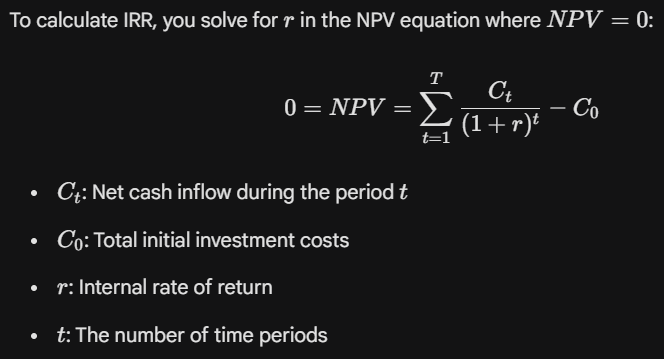
The IRR Formula
Strategic Importance in 2026
In today’s fast-moving economy, IRR helps investors cut through the noise of “total profit” and look at “efficiency”:
- Comparison Tool: You can use IRR to compare a physical real estate investment with a crypto-staking strategy. It levels the playing field across different asset classes.
- The Reinvestment Assumption: A common pitfall in 2026 is assuming you can reinvest the cash flows at the same high IRR. If you have a project with a 40% IRR, it is unlikely you can find another 40% project immediately, which is why some analysts prefer the Modified IRR (MIRR).
- Private Equity & VC: In 2026, Venture Capital and Private Equity firms are judged almost entirely on their “Net IRR” to their Limited Partners.
Maximize Your Portfolio’s IRR
To achieve a high IRR, you need assets that provide consistent, early cash flows or high capital appreciation. These platform pairings are the 2026 standard for identifying and capturing high-return opportunities:
- Flippa & Fintown: When you buy a digital business on Flippa, you are often looking for a “Quick Win”—an asset you can optimize and flip for a high IRR in 12–18 months. While you manage these high-growth digital assets, Fintown provides a reliable, fixed-income baseline. By investing in real estate-backed loans on Fintown, you secure a predictable yield that helps stabilize your overall portfolio IRR against the volatility of the tech market.