

CEX vs DEX: Which Exchange Is Best for Professional Traders?
The choice between Centralized (CEX) and Decentralized (DEX) exchanges has evolved from a simple matter of convenience into a highly sophisticated strategic decision. For professional traders, the priority is no longer just finding a platform that functions, but optimizing for execution speed, regulatory safety, and structural capital efficiency.
In the current market, centralized titans continue to command a dominant share of total spot volume, driven largely by their established custody networks and institutional fiat on-ramps. However, high-performance, order-book-centric decentralized networks are no longer experimental novelties—they have matured into highly robust, institutional-grade trading infrastructure.
1. Centralized Platforms: Unrivaled Latency and Regulated On-Ramps
For high-frequency algorithmic traders (HFTs), market makers, and institutional allocators executing massive block orders, the centralized matching engine remains a core component of trading operations.
High-Speed Order Execution
Centralized engines process trades off-chain via proprietary matching systems, delivering sub-millisecond execution speeds that on-chain distributed ledgers cannot fundamentally match. For traders running latencies where milliseconds translate to slippage, premier venues like Bybit and Binance provide the necessary throughput to manage complex, high-velocity order books.
The Institutional Fiat Gateway
The primary moat for premier CEX platforms is their integration into the traditional banking sector. With the full implementation of structural frameworks like Europe’s MiCA (Markets in Crypto-Assets) regulation and heightened oversight from North American watchdogs, regulated venues like Coinbase Advanced and Gemini operate as essential, compliant gateways. They handle the exhaustive KYC (Know Your Customer) and AML (Anti-Money Laundering) requirements mandated by institutional capital, offering corporate insurance policies and regulatory protections that decentralized protocols cannot provide.
2. Decentralized Platforms: Radical Transparency and Self-Custody
The institutional mantra of “not your keys, not your coins” transitioned from a retail slogan to a rigid professional standard following historic centralized exchange insolvencies. Modern decentralized infrastructure completely neutralizes counterparty risk by allowing traders to maintain absolute control of their operational capital.
The Rise of High-Performance On-Chain Order Books
The era of slow Automated Market Makers (AMMs) causing massive slippage on large-block orders has been eclipsed by decentralized order-book infrastructure. Next-generation platforms like Hyperliquid and dYdX have successfully bridged the user-experience gap between centralized and decentralized trading.
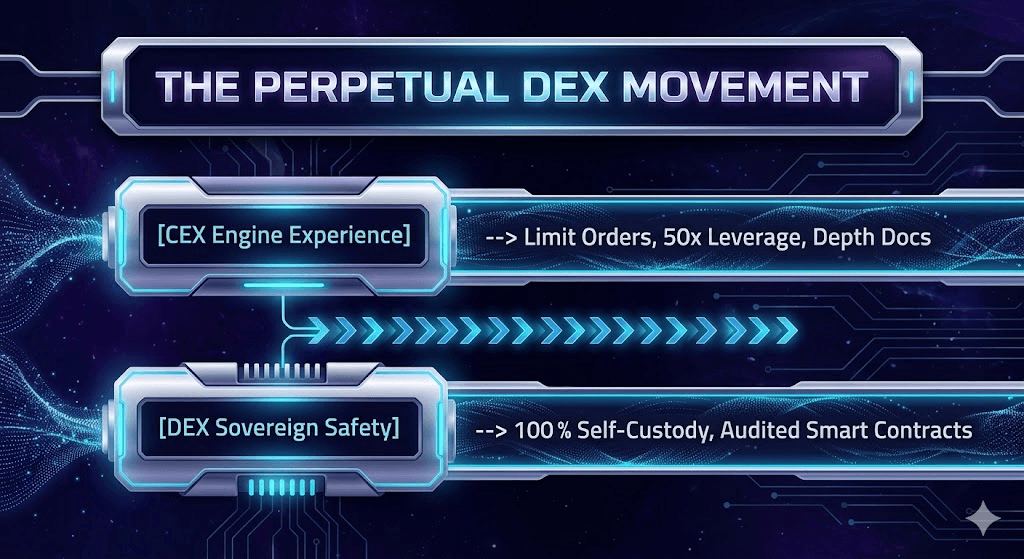
Hyperliquid, built on its own dedicated, high-throughput L1 chain, now commands over 55% of the total value locked (TVL) in the perpetual DEX sector, handling billions in daily trading volume. It allows professional traders to utilize up to 50x leverage, manage limit orders, and tap into deep liquidity pools without exposing their underlying capital to centralized exchange insolvency risks.
Immediate Alpha via Exotic Listings
Because decentralized protocols are inherently permissionless, they can launch new trading pairs instantly based on immediate market demand. While a regulated CEX might spend months conducting rigorous legal and compliance evaluations before listing a token, decentralized perpetual platforms utilize advanced decentralized upgrade models (such as HIP-3) to introduce markets immediately.
This agility allows agile professional traders to capture massive early-stage alpha in rapidly emerging sectors—including tokenized real-world assets (RWAs), cross-border commodities like physical silver or crude oil futures, pre-IPO equity tracking contracts (such as SpaceX), and decentralized prediction markets—long before they reach mainstream centralized platforms.
3. Structural Fee Architecture: Protecting Trading Margins
Fees represent the primary drain on professional trading margins. When running high-volume, programmatic strategies, analyzing the hidden costs of execution is paramount.
| Exchange Category | Platform / Tool | Maker / Taker Fee Base | Structural Margin Factors |
| Centralized (CEX) | Binance | 0.02% / 0.04% (VIP Scaled) | Minimal fees; requires native BNB holding tokens to unlock max discounts. |
| Centralized (CEX) | Bybit | 0.01% / 0.06% (UTA Scaled) | Advanced Unified Trading Account splits collateral across spot/perps. |
| Centralized (CEX) | Coinbase Advanced | 0.00% – 0.40% (Tiered) | Higher structural fee floor for mid-volume operators; elite custody. |
| Decentralized (DEX) | Hyperliquid | -0.002% (Rebate) / 0.025% | Highly competitive fee structures with automated gas abstraction. |
| DEX Aggregators | Jupiter / 1inch | Protocol Routing Split | Zero direct platform markup; routes across L2s to neutralize slippage. |
Centralized VIP Tiers
On high-volume CEX venues, professional traders operating within institutional VIP tiers can scale their maker fees down to near-zero, or even collect negative maker fees (rebates) via market-making programs. However, these benefits require locking up significant capital in native exchange utility tokens (like BNB) or maintaining millions of dollars in monthly trading volume.
Decentralized Gas Abstraction and Aggregation
On the decentralized side, nominal platform trading fees are often lower, but traders must historically factor in network transaction fees (gas) and price slippage.
With the maturation of ultra-low-cost Layer 2 scaling solutions (such as Arbitrum and Base) and hyper-optimized layer-1 chains, network gas costs have dropped to fractions of a cent. Furthermore, professional-grade decentralized aggregators like Jupiter (on Solana) and 1inch automatically slice and route large orders across dozens of independent liquidity pools simultaneously, mitigating slippage and routinely delivering better net pricing than single centralized exchanges.
4. The Professional Choice: A Diversified Hybrid Framework
The most profitable portfolio managers in the digital asset landscape do not lock themselves into a single ecosystem. Instead, they deploy a sophisticated, hybrid architecture that extracts unique structural advantages from both environments.
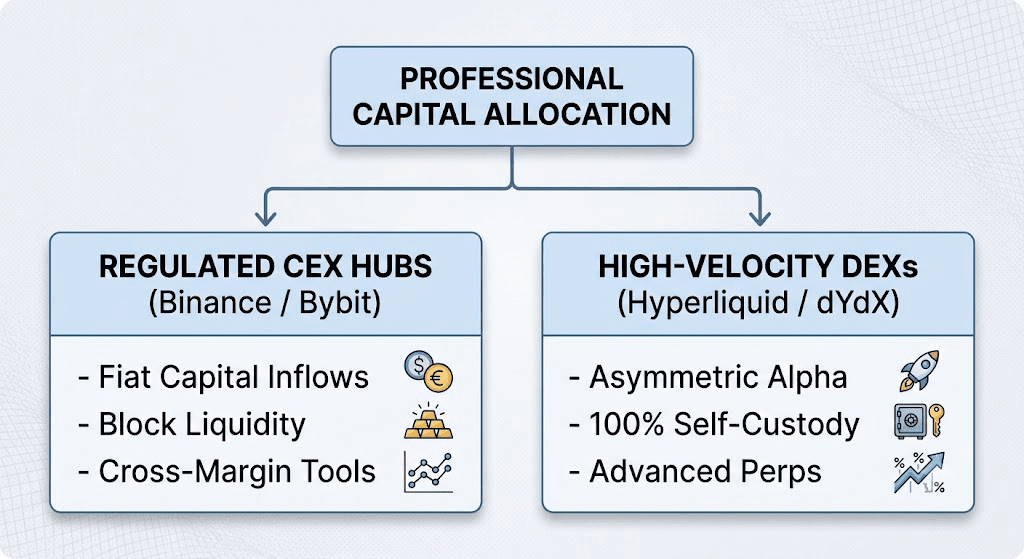
Under this hybrid execution strategy:
- Centralized Infrastructure (Binance and Bybit) is utilized as the primary gatekeeper for large-scale fiat movements, core institutional spot custody, and clearing high-volume, regulated derivatives.
- Decentralized Networks (Hyperliquid) house active, high-velocity trading capital used to hunt short-term market anomalies, access early-stage asset listings, and trade leverage-heavy perpetual contracts directly from secure, non-custodial hardware wallets.
FAQ
Which exchange framework is truly safer for a professional entity?
Safety is entirely dependent on the specific type of risk you are mitigating. If your primary concern is counterparty default, platform insolvency, or sudden withdrawal freezes, decentralized perpetual exchanges like Hyperliquid are structurally safer because your funds remain inside non-custodial wallets. However, if your risk parameters prioritize legal recourse, institutional compliance audits, and protection against complex smart-contract code bugs, traditional regulated centralized entities like Coinbase provide a more robust legal airbag.
Why does Binance remain a consistent global benchmark for fee structures?
Binance maintains its position as an industry benchmark due to its massive, self-reinforcing liquidity depth and aggressive fee scaling. Its standard base trading fee starts at a highly competitive 0.1%, which instantly drops by 25% to 0.075% if fees are settled using the platform’s native BNB token. For high-volume institutional VIPs, these rates scale down to near-zero, making it one of the most cost-effective liquidity venues on earth.
Can I utilize cross-margin features on a decentralized platform?
Yes. High-performance decentralized trading ecosystems have fully integrated unified cross-margin capabilities. Platforms like Hyperliquid feature a specialized margin engine that allows traders to utilize their entire account equity balance—across various open spot assets and unrealized perpetual profits—to collectively collateralize high-leverage derivative contracts, mimicking the capital efficiency of an institutional CEX brokerage account.
How does the European MiCA regulation impact centralized operations?
The MiCA (Markets in Crypto-Assets) framework enforces strict operational transparency, audited reserve mandates, and explicit consumer protection laws on centralized entities operating within the European Union. While this dramatically expands institutional confidence and clears the path for massive corporate capital inflows, it simultaneously forces CEX platforms to implement highly conservative listing policies, severely restricting their ability to offer long-tail, unvetted tokens to professional traders.
How do decentralized aggregators eliminate execution slippage?
Aggregators like Jupiter and 1inch utilize advanced proprietary routing algorithms to analyze the depth of every independent liquidity pool across the entire blockchain in real time. When a professional trader inputs a large-scale order, the aggregator instantly fractures the block into optimized fractions, routing them across multiple decentralized venues concurrently. This distributed execution prevents a single liquidity pool from experiencing extreme price impact, ensuring the trader achieves optimal execution pricing.